
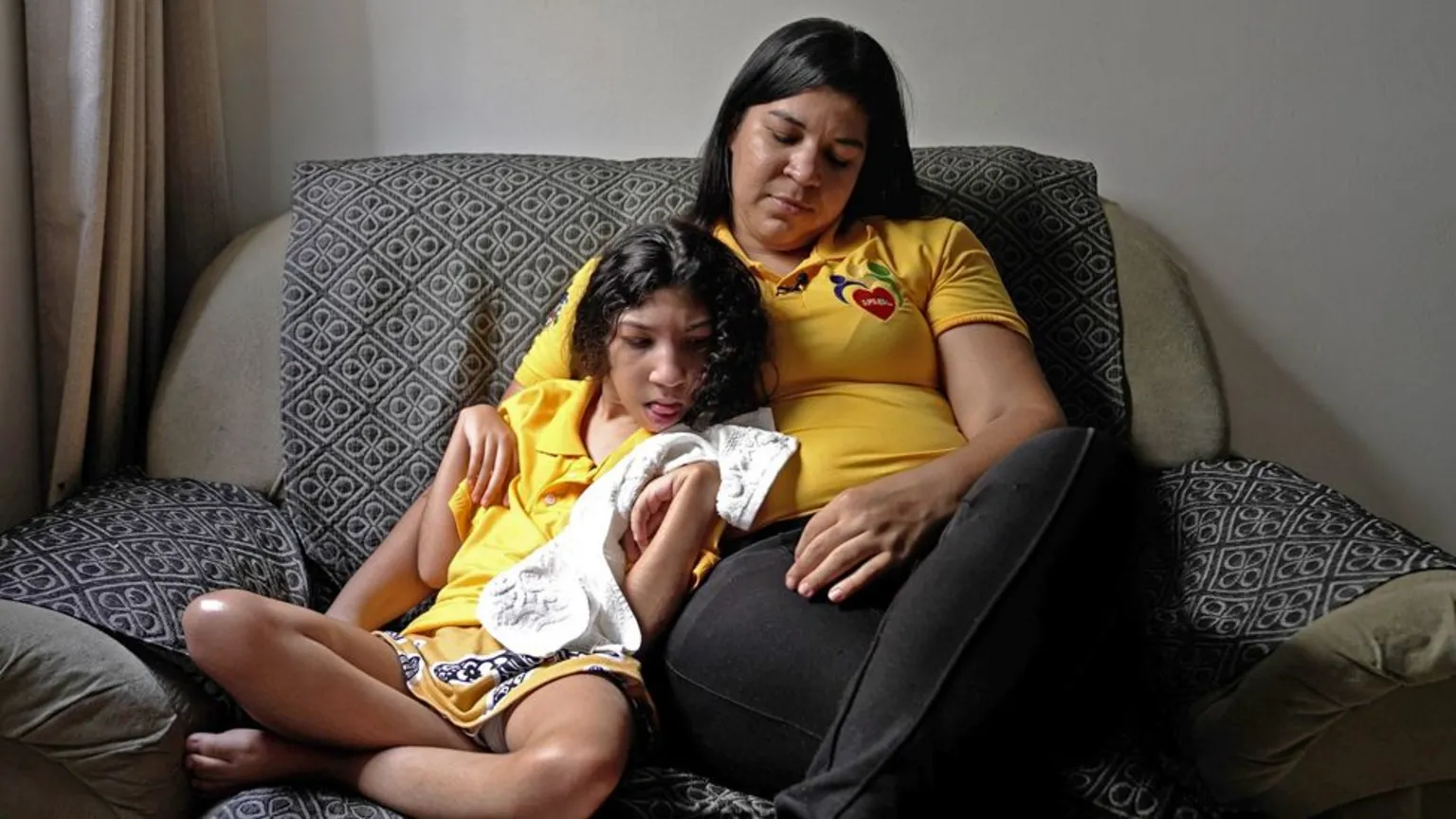
When Rute Freires was told by a doctor that her newborn daughter Tamara wouldn’t live long, she started crying uncontrollably.
Tamara had microcephaly – an abnormally small head – one of many conditions resulting from her mother being infected with the Zika virus while pregnant.
Now nine-years-old, Tamara eats through a stomach tube. Her hands are increasingly stiff and contracted and she has a hard time holding her head still.
“I was told early on that she wouldn’t walk, she wouldn’t speak nor smile,” says Rute.
“And yet I would ask every doctor I visited: ‘My kid is going to walk, right?'”
Rute’s daughter is one of the nearly 2,000 babies born to women who contracted the mosquito-borne virus in Brazil between 2015 and 2016.
Back then, the country was preparing to host the Olympics and the world watched with concern as the virus spread across Brazil as well as to dozens of other countries.
A public health emergency was declared by the World Health Organization and Brazilian authorities, whose warning remained in place until May 2017.
It’s still not clear why the outbreak spontaneously ceased and it hasn’t resurged over the past decade.
Zika disappeared from the public eye, and families dealing with its long-lasting consequences have been largely forgotten.
According to government figures, 261 children diagnosed with congenital Zika syndrome – a pattern of birth defects caused by infections during pregnancy – have died. Hundreds more have seen their health conditions deteriorate.
Tamara is one of them. She lives in Maceió, a coastal city in north-eastern Brazil, where 75% of the cases of congenital Zika virus syndrome in the country were registered.